Category: Uncategorized

  • Five Costly Mistakes When Ordering Custom Bottle Boxes (and How to Avoid Them)

    Five Costly Mistakes When Ordering Custom Bottle Boxes (and How to Avoid Them)

    A custom bottle box is one of those orders where the details are the whole job. The artwork can be beautiful and the price can be right, and the project can still go wrong because the insert is a few millimeters too tight, the board is too thin for the weight it carries, or the order was placed two weeks too late for the date it was meant for. Most of the expensive missteps are predictable, and they cluster around the same handful of decisions. Here are the five that catch buyers most often, and the concrete way to avoid each one.

    Mistake one: assuming every 750 ml bottle is the same size

    The most common and most costly error is treating “750 ml” as a single dimension. It is a volume, not a shape, and the common wine styles differ enough at the base that an insert cut for one will not accept another. A Bordeaux bottle runs around 76 mm across; a Burgundy is noticeably wider at roughly 84 mm; a Champagne bottle, built for pressure, is wider still at about 92 mm; and a magnum jumps to around 102 mm. A snug Bordeaux die-cut simply will not take a Champagne bottle, and a box sized for Champagne leaves a Bordeaux rattling. Before you approve anything, measure the actual bottle you are shipping, at its widest point and its full height with the capsule on, and spec the insert to that. If you plan to pack more than one bottle shape over time, size to the largest or order separate inserts rather than hoping one fits all.
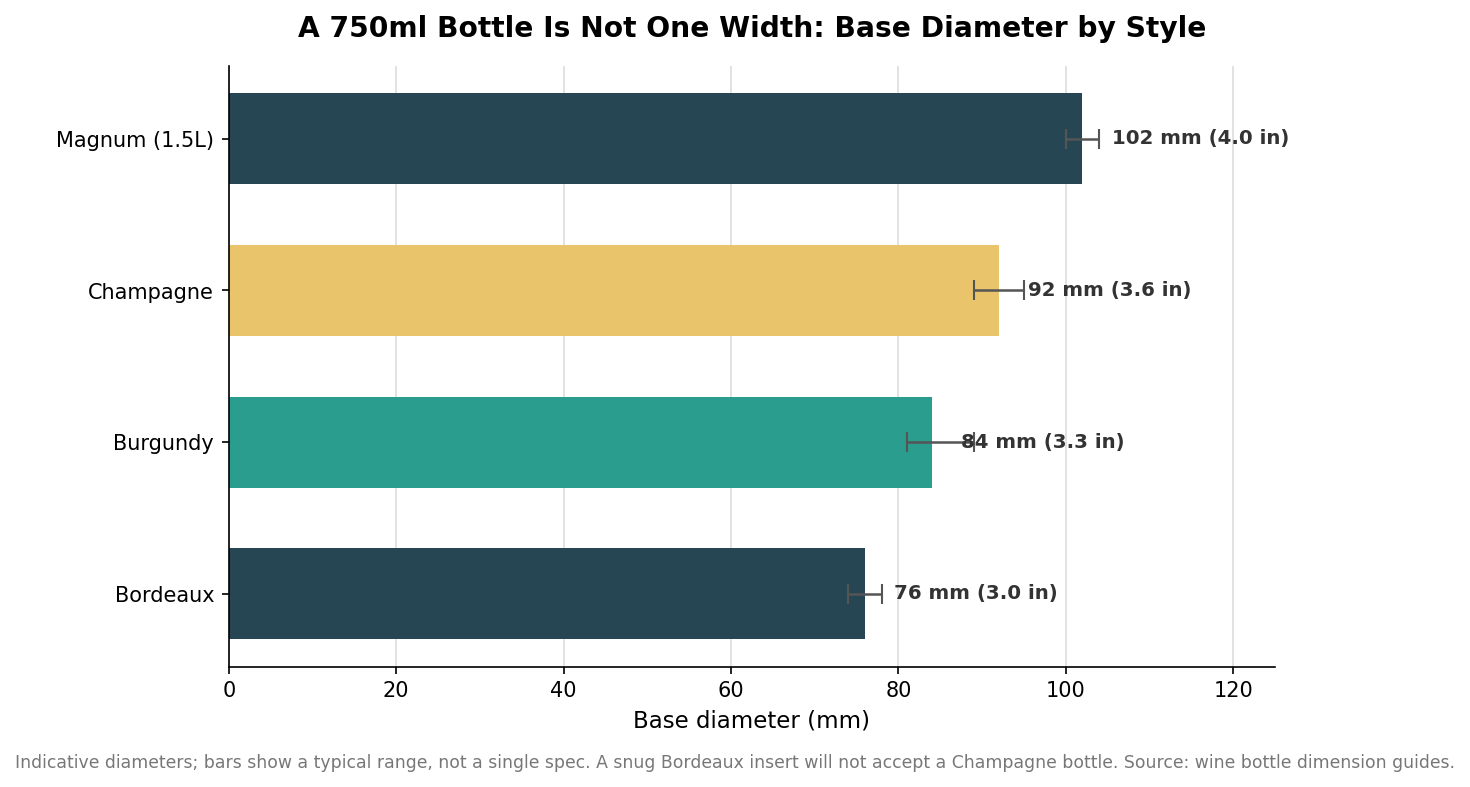
    Bar chart of base diameter for Bordeaux, Burgundy, Champagne and magnum bottles
    Common 750ml styles differ by roughly 15 to 20 mm at the base, so one insert rarely fits all.

    Mistake two: choosing the board for its print surface, not its load

    Corrugated comes in flute grades, and they are not interchangeable. Thin fine flutes like E at roughly 1.5 mm and B at about 3 mm give a smooth face that prints beautifully, which is exactly why buyers reach for them, and exactly how a heavy glass bottle ends up in a box that crushes in transit. The thicker grades exist for a reason: C flute at around 4 mm balances printability with cushioning, and double-wall BC at about 7 mm is built to carry weight and absorb shock. The right move is to let the job decide. A retail box that sits on a shelf and is carried home can lean on a fine flute for the print; a box that will be couriered with a full bottle inside wants C or a double-wall, often with a printed sleeve or litho-laminated liner so you still get the finish without giving up the protection. Pick the strength first, then solve for print.
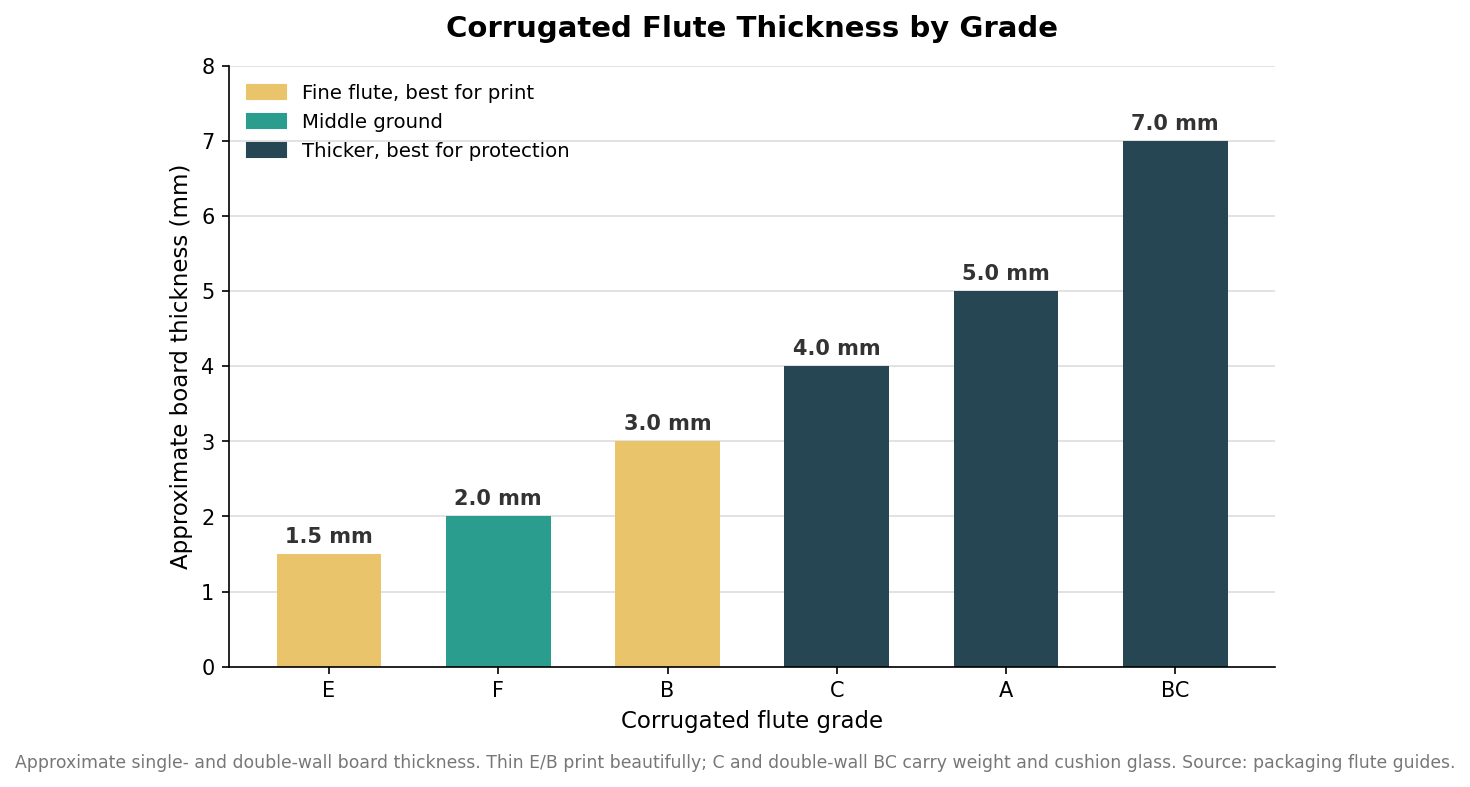
    Bar chart of corrugated flute thickness by grade, colored by best use for print or protection
    Fine E and B flutes print well; C and double-wall BC carry the weight and cushion glass.

    Mistake three: confusing a gift box with a shipper

    A presentation box and a shipping box are two different products, and buying one when you need the other is a quiet disaster. A magnetic-closure rigid box or a slim printed carton is designed for the unboxing moment: it looks and feels premium in the hand, but it is not engineered to survive a parcel network alone. If a bottle is going to travel by carrier, it needs a box and insert system that has actually been drop-tested, and if the contents are alcohol there are carrier and legal rules layered on top of the packaging question. The clean solution is to separate the two jobs. Let the beautiful box be the gift, and put it inside a tested shipper, or choose a mailer specifically rated for glass. Do not ask a gift box to do a shipper’s work, and do not ship wine without confirming both the drop performance and the rules that apply to where it is going.

    Mistake four: designing artwork without the substrate in mind

    Print does not look the same on every surface, and designs approved on a screen can disappoint on the real material. A photographic, full-color design that sings on a coated rigid box can look muddy printed directly onto brown kraft corrugated, because the surface and its color shift everything. Premium effects add their own rules: foil stamping, embossing and spot gloss read very differently on a smooth coated stock than on an uncoated or fluted one, and fine flutes can telegraph washboarding through a solid ink area. Decide the material and finish early, ask for a physical proof or a production sample on the actual stock rather than signing off on a flat digital rendering, and design to the substrate’s strengths. It is far cheaper to adjust a file than to reprint a run.

    Mistake five: underestimating minimum orders and lead time

    Custom packaging runs on tooling and schedules, and both take longer than a first-time buyer expects. Custom die-cuts, print plates and rigid-box setup carry minimum order quantities and setup costs that only make sense across a run, and the more specialized the format, the higher the floor. Lead times stack up too: design and proofing, then production, then any finishing, then transit, and the calendar does not care that your launch, your wedding, or your holiday gifting window is fixed. The fix is simple discipline. Ask for the MOQ and the full lead time in writing before you fall in love with a format, build in a buffer for a second proof round, and back-plan from the date the boxes must be in hand rather than the date you would like to order. A rush on a bespoke box is either impossible or expensive, and usually both.

    None of these mistakes require special expertise to avoid; they require measuring the real bottle, matching the board to the load, keeping the gift box and the shipper as separate jobs, proofing on the actual material, and starting early enough to breathe. Handle those five and the rest of a custom bottle box order tends to go smoothly, which is exactly what you want from packaging whose entire purpose is to make the thing inside feel considered.
  • How to Spec a Custom Bottle Box: Measuring the Bottle, Fit, Format and Closure

    How to Spec a Custom Bottle Box: Measuring the Bottle, Fit, Format and Closure

    A bottle box only works if the bottle fits it, and “750 milliliters” tells you almost nothing about fit. Two bottles of the same volume can differ by more than a centimeter in diameter and several centimeters in height depending on whether they are Bordeaux, Burgundy, Champagne, or a squat spirits flask. Speccing a custom box well is a short, ordered set of decisions that starts with the physical bottle in your hand and ends with a proof you have actually test-fitted. Here is the sequence that avoids the two classic failures: a box the bottle rattles around in, and a box the bottle will not slide into at all.

    Start with the bottle, not the volume

    Measure the actual bottle you are shipping, not a generic figure. Take three numbers with calipers or a tape: the maximum body diameter, the overall height including the capsule or closure, and, if the shape is unusual, the shoulder width where the bottle is widest. A standard Bordeaux 750 runs roughly 75 to 81 millimeters across and about 290 to 305 millimeters tall, but a Burgundy bottle spreads wider to around 86 millimeters, and a Champagne bottle is both wider and heavier, often 89 millimeters or more in diameter. Spirits are the wild card, ranging from tall and slim to short and square, so a general chart is a starting point and never a substitute for measuring the exact bottle. If you plan to change bottle suppliers later, measure a sample from each, because a box tuned to one mold may reject another.

    Build in the right clearance, then choose an insert

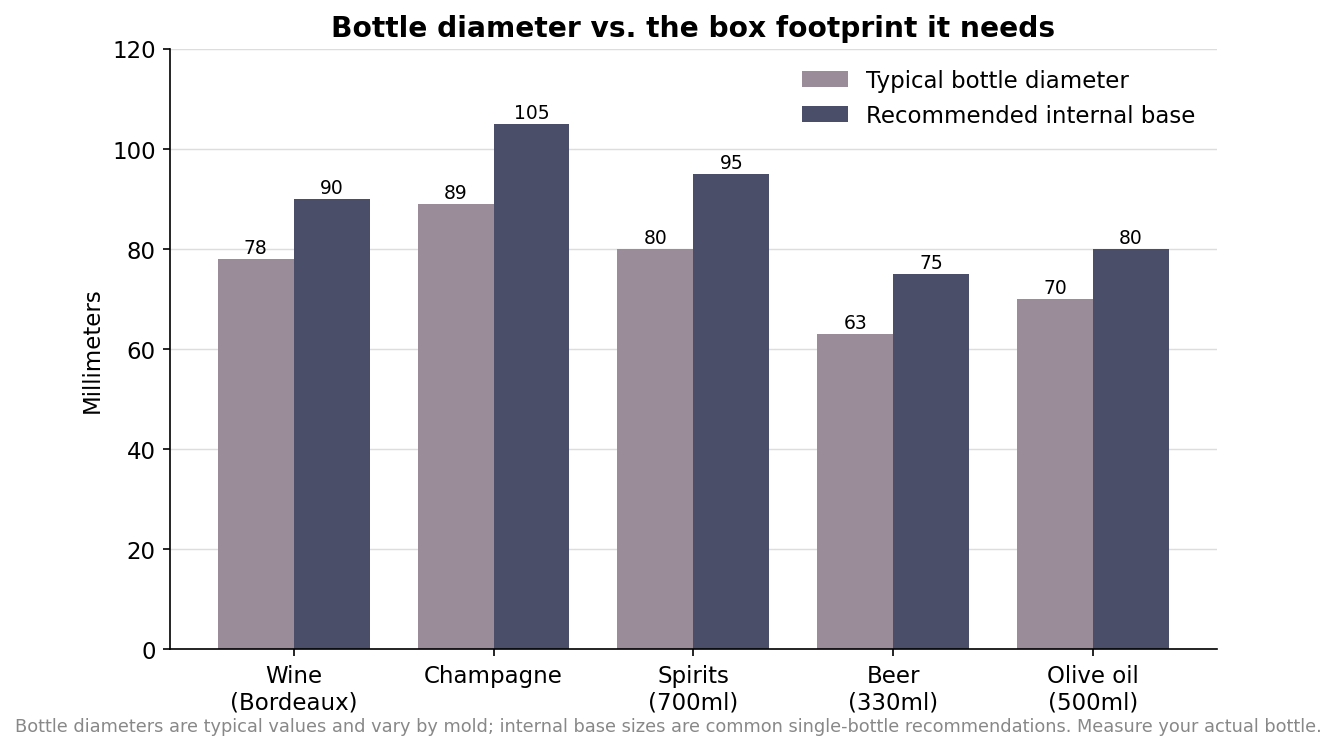
    Add three to five millimeters of clearance around the bottle so it slides in without forcing and comes out without a fight. Too tight and your packing line slows to a crawl and the label scuffs on the way in; too loose and the bottle moves in transit, which is exactly what breaks glass. That clearance is why a Bordeaux bottle near 78 millimeters across lives comfortably in a box with an internal base around 90 millimeters, and a Champagne bottle sits in something closer to 105 millimeters. The grouped comparison below shows how the box footprint tracks the bottle it has to hold.

    Grouped bar chart comparing typical bottle diameter to recommended internal box base width for wine, champagne, spirits, beer and olive oil
    The internal footprint tracks the bottle’s diameter plus a few millimeters of clearance on each side.

    The insert is what turns clearance into protection. Molded pulp and molded-fiber trays cradle the base and shoulder, are plastic-free, and photograph well for a sustainability story. PE foam gives the softest hold and suits heavy or luxury bottles. For simple gift boxes, a die-cut corrugated insert or a snug foam collar keeps the bottle centered. Whatever you choose, the insert should locate the bottle in all directions, not just stop it falling out the top, because side-to-side movement during a drop is what cracks a punt or chips a shoulder.

    Match the internal height to the bottle and the lid

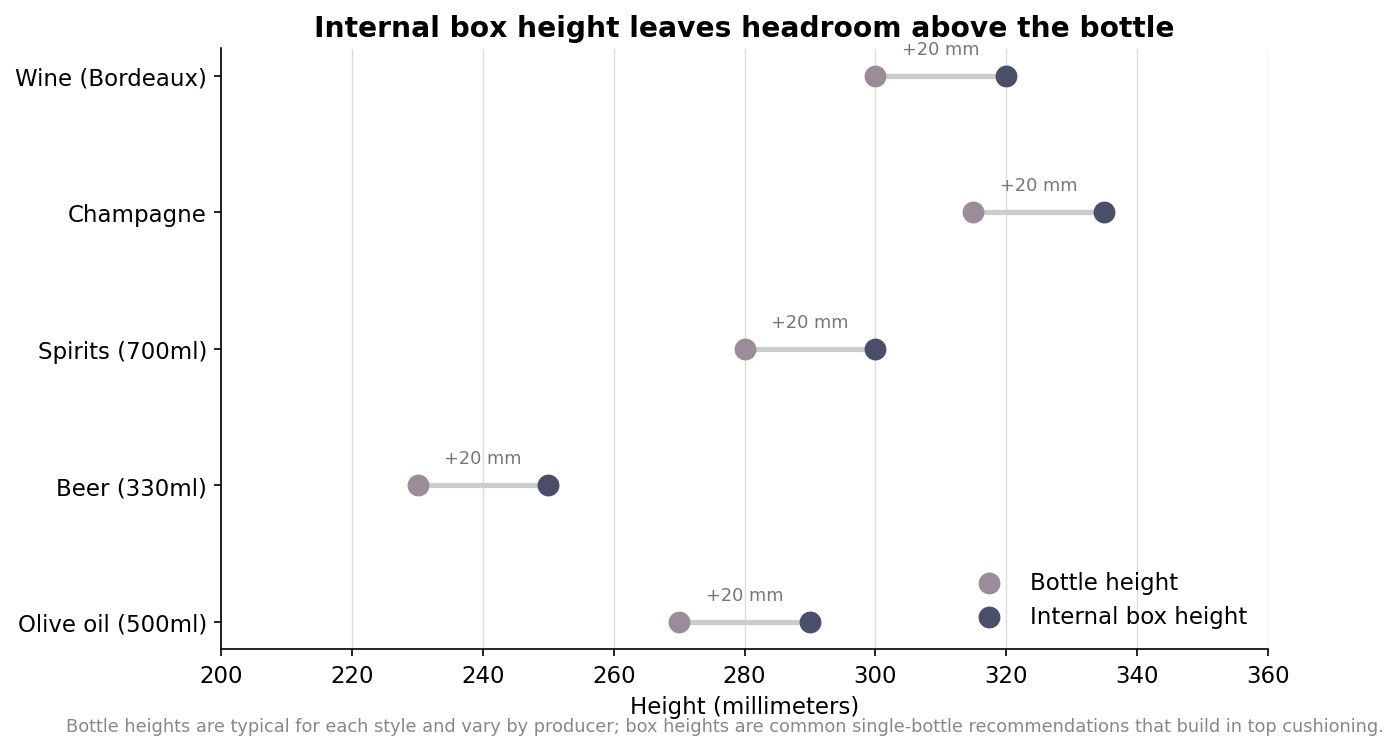
    Height needs its own margin, separate from the side clearance. Leave roughly 15 to 25 millimeters of headroom above the closure so the lid seats without pressing on the cap and so a top cushion has somewhere to sit. That is why a Bordeaux bottle around 300 millimeters tall pairs with an internal box height near 320 millimeters. Get this wrong in the tight direction and the lid bows or will not close; get it wrong in the loose direction and the bottle telescopes upward on a drop and punches the top of the box. The dumbbell chart below shows the consistent headroom built into common single-bottle sizes.

    Dumbbell dot plot comparing typical bottle height to recommended internal box height, showing headroom for each bottle type
    Common single-bottle sizes build in roughly 20 mm of headroom above the closure for the lid and cushioning.

    Pick the format and the closure

    Format follows the job. A corrugated mailer with a molded insert is the right answer when the box will travel through a carrier network on its own; it is engineered to absorb drops and is comparatively cheap at volume. A rigid setup box with a wrapped finish is the right answer for retail shelf presence or a gift that will be handed over in person, where the unboxing matters more than freight economics. Many brands run both: a handsome rigid box nested inside a plain corrugated shipper for e-commerce.

    Closure sets the moment the box is opened. A tuck-end or auto-lock bottom is fast to pack and fine for shippers. A magnetic-closure rigid box feels premium and reusable but adds cost and weight. A lift-off lid or a sleeve-and-tray reads as a gift and slows the reveal in a good way. Decide single versus multi-bottle here too, because a two- or three-bottle box needs dividers so each bottle travels in its own pocket, and the combined weight climbs fast: a full 750-milliliter wine bottle runs roughly 1.2 to 1.3 kilograms, so a three-bottle presentation is approaching four kilograms before the packaging, which changes both the board grade you need and the shipping cost.

    Proof it, then test-fit before the run

    Before you approve artwork, confirm the dieline lists internal dimensions, not external, because the printer’s tooling is cut to the outside and a few millimeters of board thickness on each wall eats into the space the bottle actually sees. Order a physical sample or a plotter-cut mockup and put your real bottle into it. Check that it slides in cleanly, that the insert holds it still when you tip and gently shake the closed box, and that the lid seats flat. The figures in this guide are typical planning numbers and vary by bottle mold, board caliper, and insert type, so treat them as a way to get close and let a test-fit settle the final dimensions. A box you have personally loaded and closed around the exact bottle is worth more than any spec table.

  • How to Ship Wine Legally and Safely: Carrier Rules, Box Specs, and Drop-Test Standards

    How to Ship Wine Legally and Safely: Carrier Rules, Box Specs, and Drop-Test Standards

    Two things decide whether a bottle arrives intact and whether you are allowed to send it at all: the box has to survive a parcel network built for tumbling, stacking, and drops, and the shipment has to satisfy a web of federal and state alcohol rules that treat wine differently from almost anything else you can mail. Get the packaging right but ignore compliance, and a shipment can be refused or returned. Get the paperwork right and skimp on the box, and you are paying to ship broken glass. This guide walks through both, in the order you should think about them.

    Start with the carriers, because they narrow your options fast

    The first surprise for many first-time shippers is that the Postal Service is out entirely. Federal law prohibits USPS from carrying beer, wine, or spirits, so the cheapest option most businesses reach for is simply unavailable for alcohol. That leaves the two national private carriers, UPS and FedEx, and both require you to enroll in a dedicated alcohol program before a single bottle moves. FedEx asks shippers to sign up for its alcohol shipping program and provide proof of the appropriate licenses. UPS requires a signed contract, either an Agreement for Approved Wine Shippers or a Wine Industry Fulfillment House Agreement, with license copies submitted to its wine compliance team.

    The practical consequence is that individuals cannot legally ship wine through either carrier. Only licensed businesses qualify, and the license has to match the product and the lane. Every alcohol delivery also requires an adult 21 or older to sign at the door, with no waiver and no leave-at-door option. Build that into your customer expectations, because a missed signature means a re-attempt or a return, not a doorstep hand-off.

    The state map is the real constraint

    Carrier enrollment gets you moving, but state law decides where you can actually deliver. Direct-to-consumer wine shipping is governed state by state, and the patchwork is genuinely uneven. Most states that permit DTC wine require the recipient to be 21 or older and the shipper to hold a permit for that state. A handful, including Alabama, Utah, and Arkansas, prohibit or heavily restrict DTC wine altogether, so a box addressed there may be undeliverable no matter how well it is packed. Beer and spirits are stricter still: in most cases they are limited to licensee-to-licensee shipments, meaning the recipient must itself be a licensed alcohol business rather than a consumer. If your packaging program is built around gift shipments to individuals, confirm the destination state allows it before you promise a delivery date.

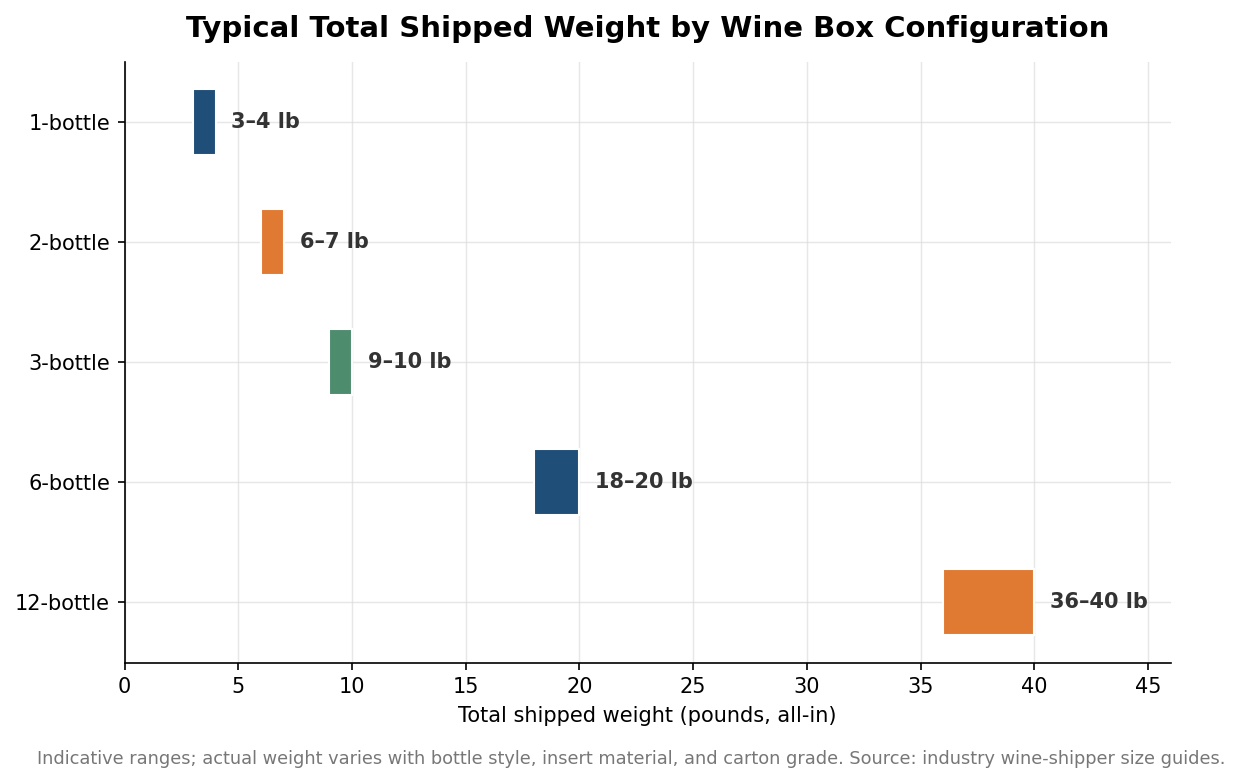
    Chart of typical total shipped weight in pounds for 1, 2, 3, 6, and 12-bottle wine boxes
    Total shipped weight climbs from about 3 to 4 pounds for a single bottle to 36 to 40 pounds for a twelve-bottle box.

    What surviving shipping actually means

    Once you can legally ship, the box has to do its job. The relevant benchmark for parcel-shipped bottles is ISTA 3A, the International Safe Transit Association test for individually shipped packages moving through a small-parcel network, generally under 150 pounds. It is not a single drop; it is a sequence that mimics the abuse a box takes in a real hub: atmospheric conditioning, a compression phase that simulates sitting at the bottom of a stack, random vibration on a shaker table, and a series of drops on faces, edges, and corners. A shipper that passes ISTA 3A has been shown to protect its contents through that whole cycle, not just one gentle test. When a supplier advertises a wine shipper as ISTA 3A tested, that is the claim worth looking for, because it maps directly to how carriers actually handle parcels.

    Total shipped weight matters here too, for cost and for how the box behaves. As an indicative range, a single-bottle shipper runs about 3 to 4 pounds all in, a two-bottle around 6 to 7, a three-bottle roughly 9 to 10, a six-bottle in the 18-to-20 range, and a twelve-bottle box lands near 36 to 40 pounds. Those figures are approximate and shift with bottle style and insert material, but they are close enough to plan freight and to notice when a quote looks wrong.

    Choosing the insert: pulp, foam, or corrugated

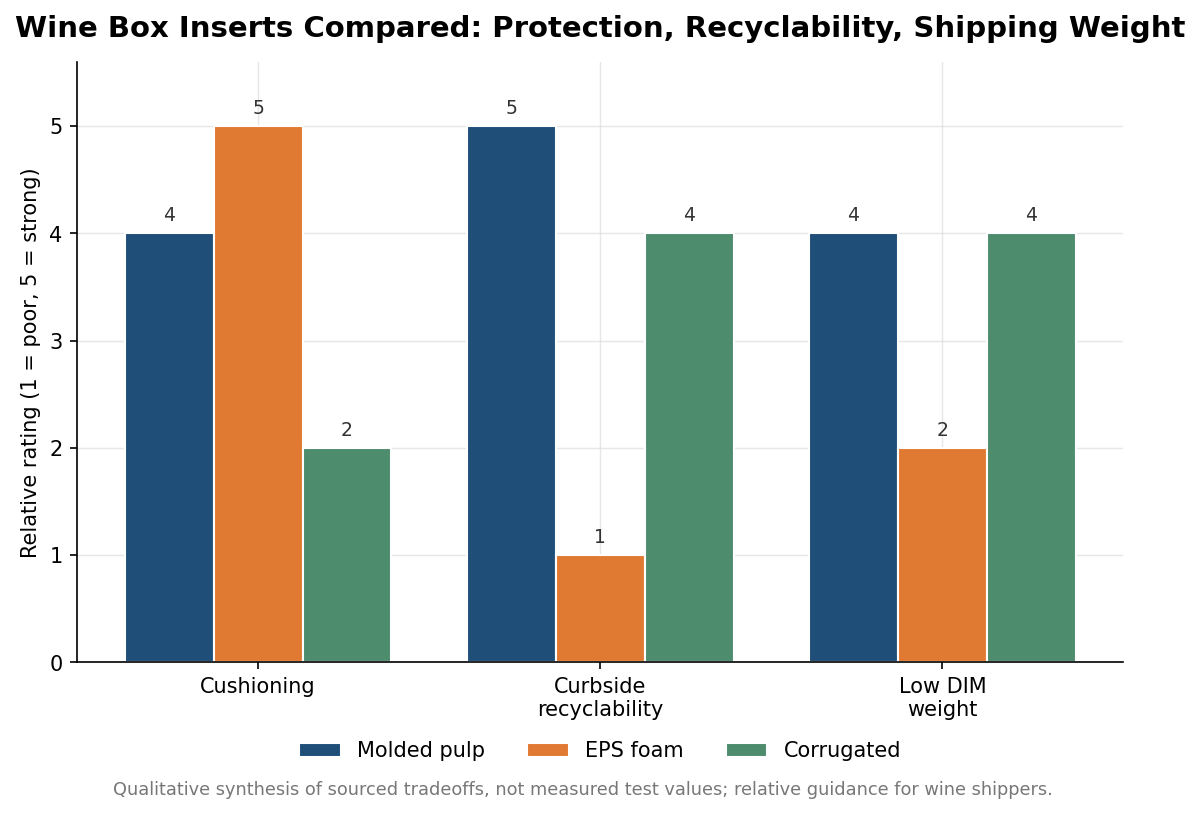
    The insert is what separates a bottle from its neighbors and from the carton wall, and the three common choices behave very differently. Molded pulp forms a product-specific cavity around each bottle so there is no movement and no glass-on-glass contact, and it is typically made from recycled paper that is curbside recyclable and compostable in most US markets, which increasingly matters to the brands sending the gift. EPS foam offers strong raw shock absorption and is favored for high-value fragile goods, but generic cut shapes can let a bottle shift on longer routes, the material adds dimensional bulk that raises DIM-weight charges, and it is not curbside recyclable and is banned from disposal in California, New York, and several other states. Corrugated dividers are the cheapest option and are good at organizing bottles and resisting stacking pressure, but they cushion relatively little and should rarely be the only protection under a glass bottle.

    The rough hierarchy for most DTC wine programs is pulp for the balance of protection, recyclability, and shipping cost; foam when maximum shock absorption outweighs the environmental and DIM penalties; and corrugated as a structural helper rather than a standalone cushion. Whatever you choose, pair it with an outer carton rated for the weight, because a twelve-bottle box near 40 pounds needs a stronger board grade than a single-bottle mailer.

    Grouped bar chart comparing molded pulp, EPS foam, and corrugated wine box inserts on cushioning, recyclability, and shipping weight
    Molded pulp balances cushioning, recyclability, and low dimensional weight; foam cushions hard but loses on recyclability and DIM.

    Specifying a box that is both compliant and drop-tested

    Put the two halves together and a good specification reads like a short checklist. Confirm the destination state allows the shipment and that you hold the matching permit; enroll with UPS or FedEx under the correct alcohol agreement; size the box to the bottle count and style you actually ship, since a Burgundy or sparkling bottle is fatter and taller than a standard Bordeaux and will not seat in a cavity cut for the wrong shape; choose an insert, pulp for most cases, that holds each bottle with no movement; and ask the supplier for ISTA 3A test evidence rather than a general promise of durability. Do that, and the box stops being the weak link. The wine arrives standing up, the recipient signs for it, and the only thing your customer remembers is the bottle, not the packaging around it.

    A note on the figures: the shipping weights and state rules above are indicative and change over time. Verify current carrier agreements and state DTC permits before you commit to a lane, since alcohol regulations are updated more often than most shipping rules.

  • Inside a Bottle Box: Corrugated Flutes, Rigid Board and the Inserts That Protect Glass

    Inside a Bottle Box: Corrugated Flutes, Rigid Board and the Inserts That Protect Glass

    A bottle box has one job that a normal carton does not: it has to protect a heavy, fragile, top-heavy glass object that will be dropped, stacked, and thrown by people who do not know or care what is inside. Whether you are a winery shipping direct to consumers, a distillery building a retail gift box, or a brand assembling wedding favors, the material and structure you choose is the difference between a package that arrives intact and one that arrives as a bag of shards and an apology email. This is a deep dive into what bottle boxes are actually made of, and how each layer contributes to keeping glass safe.

    Two families: rigid gift boxes and corrugated shippers

    The first fork in the road is what the box is for. Rigid, or setup, boxes are the premium presentation pieces: thick solid board, typically in the range of 1.5 to 3 millimeters, wrapped in printed paper, the kind of box a bottle of premium spirit sits in on a shelf or under a ribbon. They feel substantial and distribute impact across the whole structure, but on their own they are built for display and hand-carry, not for the punishment of a parcel network. Corrugated boxes are the opposite: engineered shippers whose fluted construction is designed to absorb shock and survive stacking. Many high-end products use both, a rigid box for the unboxing moment nested inside a corrugated shipper for the journey.

    Getting this distinction right up front saves money and breakage. Spending on a beautiful rigid box and then shipping it in a flimsy mailer is how expensive bottles break; conversely, over-engineering a shipper for a box that will only ever be handed across a counter wastes material. Decide whether the box is presenting, protecting, or doing both, and the rest of the spec follows.

    Flutes: the corrugation that does the cushioning

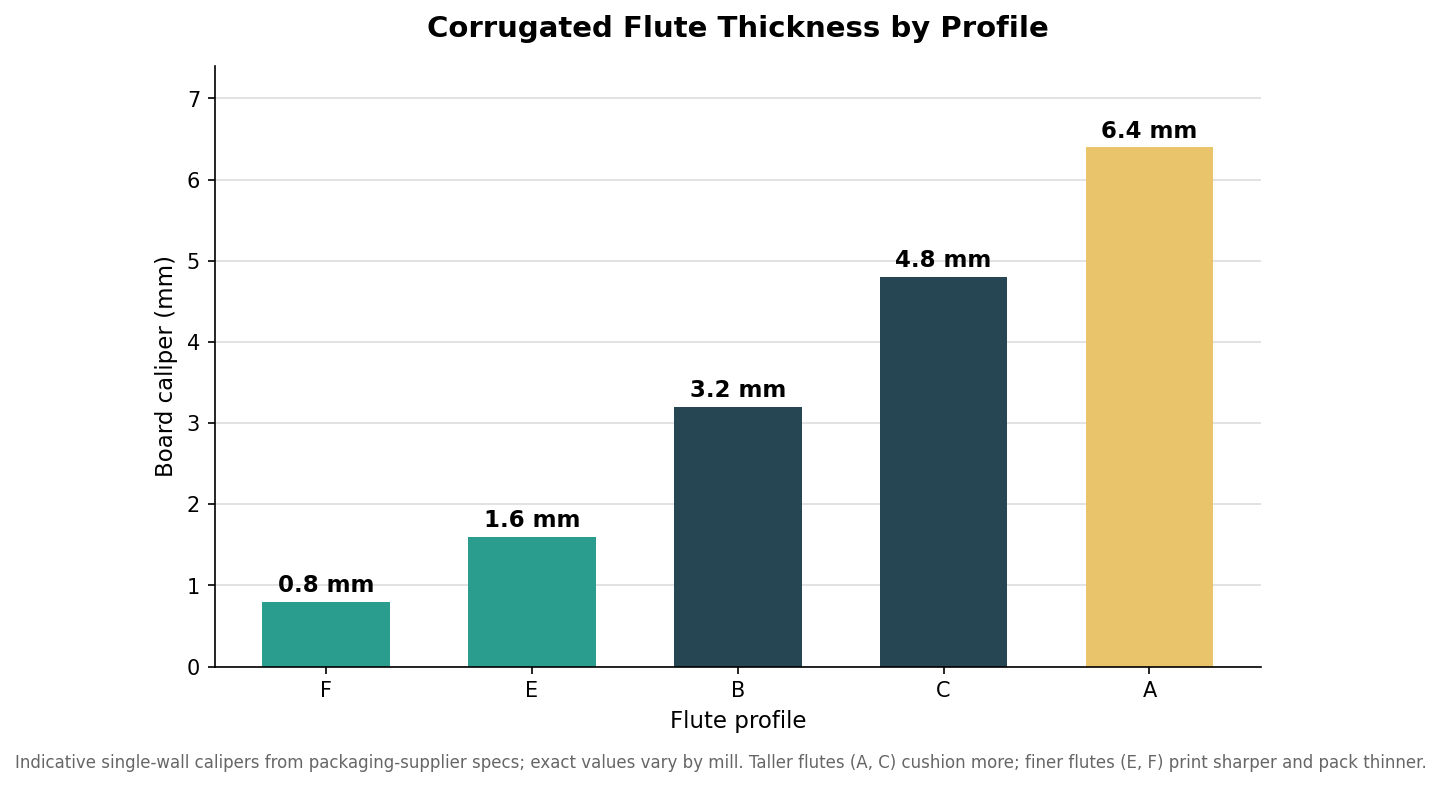
    The wavy layer sandwiched inside corrugated board is called the flute, and its profile is the single biggest lever on how a shipper performs. Taller flutes cushion more; finer flutes print sharper and pack thinner. The common profiles run from the chunky A flute down to the ultra-fine F, with B, C, and E in between. A and C flutes, being taller, give the best shock absorption and stacking strength, which is why they dominate general shipping of fragile goods. E and F flutes are thin and smooth, prized for crisp retail printing and slim luxury packaging rather than raw protection. The chart below shows the caliper of each profile so the trade-off is visible at a glance.

    Bar chart of corrugated flute caliper in millimeters for F, E, B, C and A flute profiles
    Flute caliper by profile; taller A and C flutes cushion more, fine E and F print sharper.

    For bottles specifically, the flute choice usually pairs a protective profile for the outer shipper with a finer profile where print quality matters. That is exactly what double-wall combinations like BC do: a B flute laminated to a C flute gives you both the cushioning of the taller flute and a more printable, rigid overall board, which is why BC is a workhorse for palletized bottle shipments.

    Single wall, double wall, and how many bottles

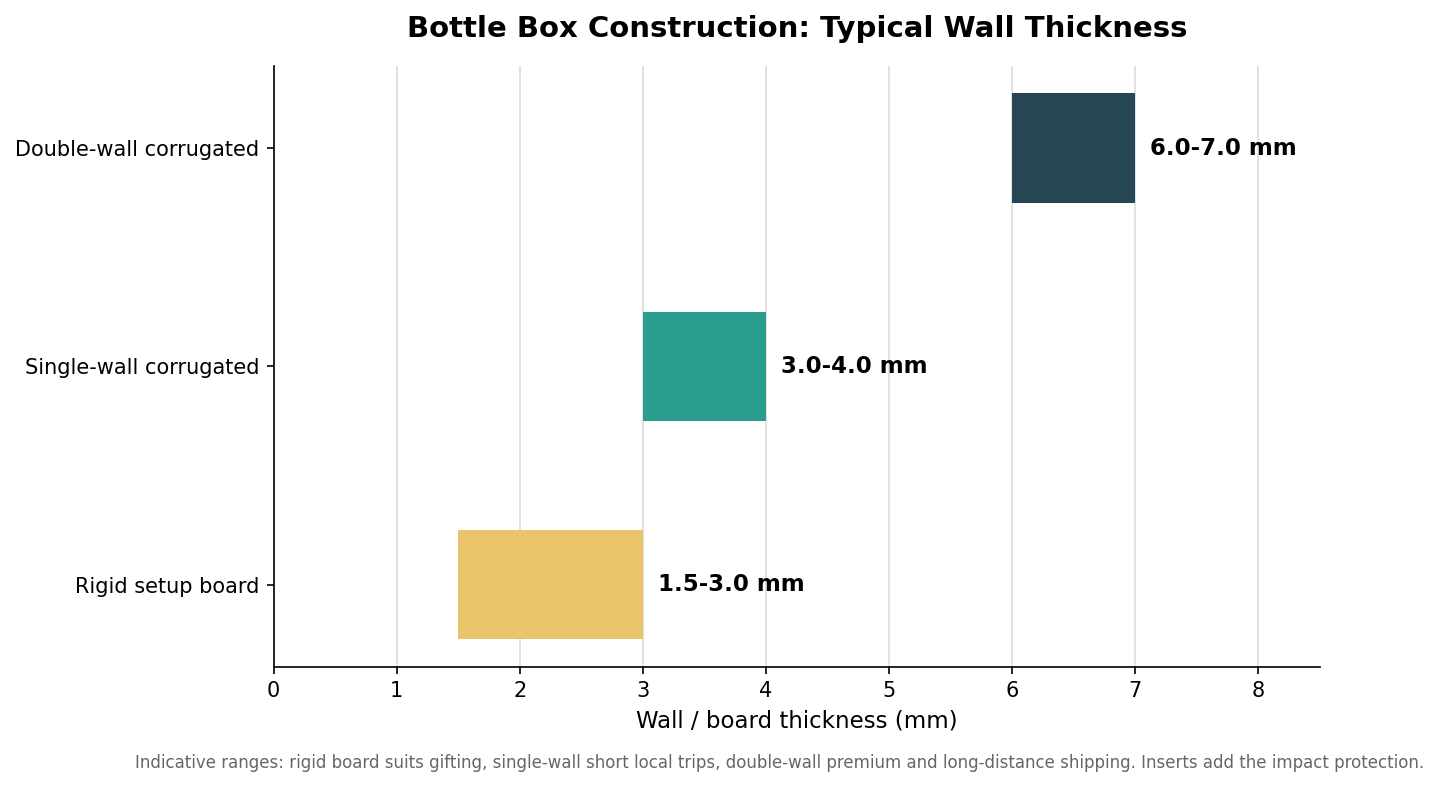
    Beyond flute profile is the question of how many layers. Single-wall board, roughly 3 to 4 millimeters thick, handles lightweight bottles over short, gentle trips; double-wall, around 6 to 7 millimeters, is the standard for premium wines, heavier bottles, and anything crossing the country or an ocean. As a rough guide from supplier specs, a six-bottle double-wall carton is commonly rated for around 20 kilograms, while larger twelve-to-twenty-four-bottle cases built from an E/B-flute hybrid can carry roughly 50 kilograms. The chart below sketches how the constructions compare on wall thickness.

    Range chart of typical wall thickness in millimeters for rigid setup board, single-wall and double-wall corrugated bottle boxes
    Typical wall thickness by construction type; inserts add the impact protection.

    Bottle count changes the physics, not just the size. A single bottle needs to be held dead center, away from every wall, because the corners and faces are where drop energy concentrates. Multi-bottle packs add a second danger: bottles knocking into each other. That is why the divider or insert matters as much as the outer box, and often more.

    Inserts: what actually stops the glass from breaking

    The outer box resists crushing and stacking; the insert resists impact and keeps bottles apart. There are three mainstream approaches. Molded pulp, shaped from recycled paper to cradle the bottle’s curves, is the most popular for wine and spirits because it suspends the bottle away from the walls, absorbs shock, nests compactly, and is fully recyclable and on-brand for sustainability messaging. Corrugated dividers and partitions, the folding grid you see in a case of wine, are cheap and effective at stopping bottle-on-bottle contact in multipacks. Foam, cut with bottle-shaped holes, often around 80 millimeters in diameter, with thin pads layered between tiers, gives precise, high-end protection at a higher cost and with a heavier environmental footprint. Air-cell wraps are a fourth option that cut packed volume significantly and deflate for disposal.

    For most direct-to-consumer wine and spirits shipping, molded pulp inside a double-wall corrugated shipper has become the default because it balances protection, cost, weight, and recyclability. For retail-ready multipacks, corrugated partitions inside a BC-flute case do the job economically. Reserve foam for genuinely high-value or oddly shaped bottles where its precision earns its cost.

    Specifying for the trip, not the shelf

    The last principle is to design for the worst moment the package will face, which is almost always transit rather than display. Reputable bottle packaging is validated against transit-simulation protocols such as the ISTA drop and vibration tests, and asking a supplier whether a design has passed that testing is a fair and revealing question. Match the outer material to the journey: rigid or single-wall for hand-off and local delivery, double-wall with a molded-pulp or partition insert for the parcel network.

    Finally, remember that structure and appearance are not in conflict. Kraft board reads natural and sustainable and takes one-color printing beautifully; white-topped or paper-wrapped board carries full-color artwork for a premium look. You can put a fine E-flute printed sleeve or a rigid presentation box around a double-wall protective core and get both the unboxing moment and the safe arrival. Decide the protection first, then the presentation on top of it, and the bottle shows up whole and looking the way you intended.