A bottle box only works if the bottle fits it, and “750 milliliters” tells you almost nothing about fit. Two bottles of the same volume can differ by more than a centimeter in diameter and several centimeters in height depending on whether they are Bordeaux, Burgundy, Champagne, or a squat spirits flask. Speccing a custom box well is a short, ordered set of decisions that starts with the physical bottle in your hand and ends with a proof you have actually test-fitted. Here is the sequence that avoids the two classic failures: a box the bottle rattles around in, and a box the bottle will not slide into at all.
Start with the bottle, not the volume
Measure the actual bottle you are shipping, not a generic figure. Take three numbers with calipers or a tape: the maximum body diameter, the overall height including the capsule or closure, and, if the shape is unusual, the shoulder width where the bottle is widest. A standard Bordeaux 750 runs roughly 75 to 81 millimeters across and about 290 to 305 millimeters tall, but a Burgundy bottle spreads wider to around 86 millimeters, and a Champagne bottle is both wider and heavier, often 89 millimeters or more in diameter. Spirits are the wild card, ranging from tall and slim to short and square, so a general chart is a starting point and never a substitute for measuring the exact bottle. If you plan to change bottle suppliers later, measure a sample from each, because a box tuned to one mold may reject another.
Build in the right clearance, then choose an insert
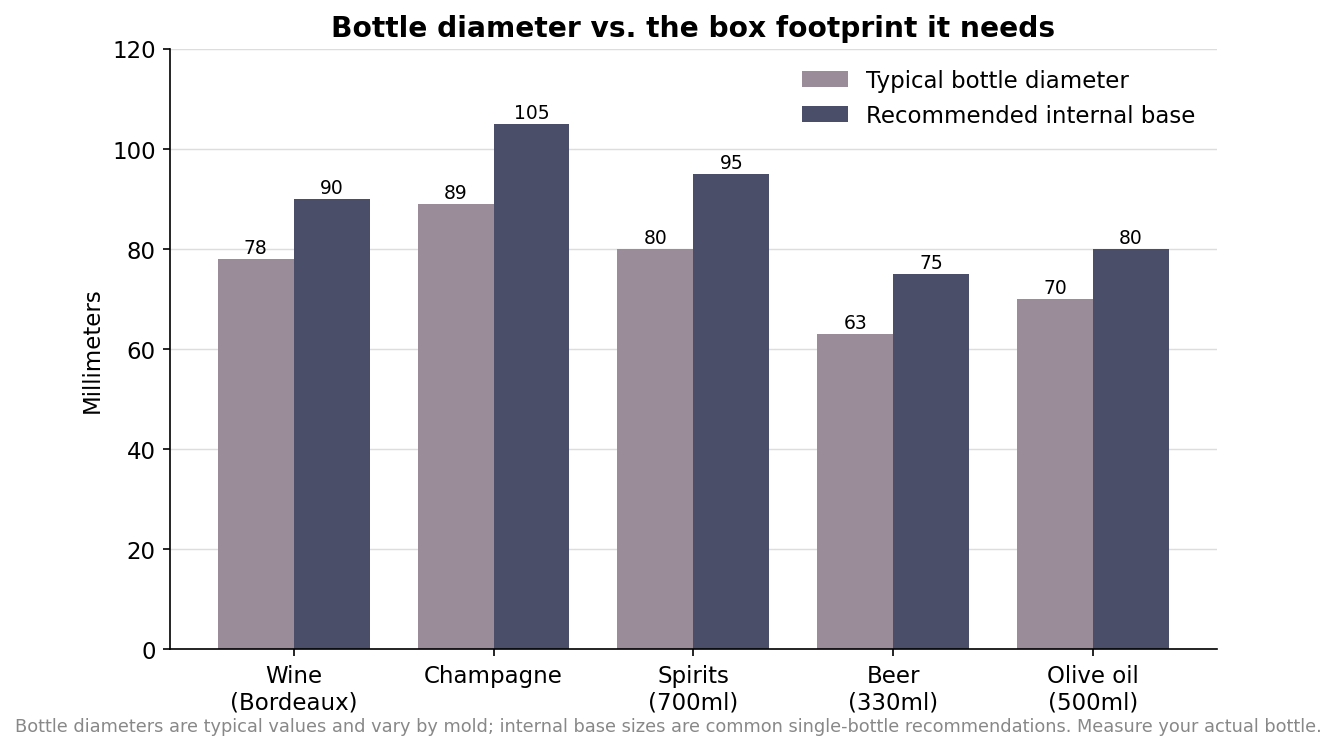
Add three to five millimeters of clearance around the bottle so it slides in without forcing and comes out without a fight. Too tight and your packing line slows to a crawl and the label scuffs on the way in; too loose and the bottle moves in transit, which is exactly what breaks glass. That clearance is why a Bordeaux bottle near 78 millimeters across lives comfortably in a box with an internal base around 90 millimeters, and a Champagne bottle sits in something closer to 105 millimeters. The grouped comparison below shows how the box footprint tracks the bottle it has to hold.
The insert is what turns clearance into protection. Molded pulp and molded-fiber trays cradle the base and shoulder, are plastic-free, and photograph well for a sustainability story. PE foam gives the softest hold and suits heavy or luxury bottles. For simple gift boxes, a die-cut corrugated insert or a snug foam collar keeps the bottle centered. Whatever you choose, the insert should locate the bottle in all directions, not just stop it falling out the top, because side-to-side movement during a drop is what cracks a punt or chips a shoulder.
Match the internal height to the bottle and the lid
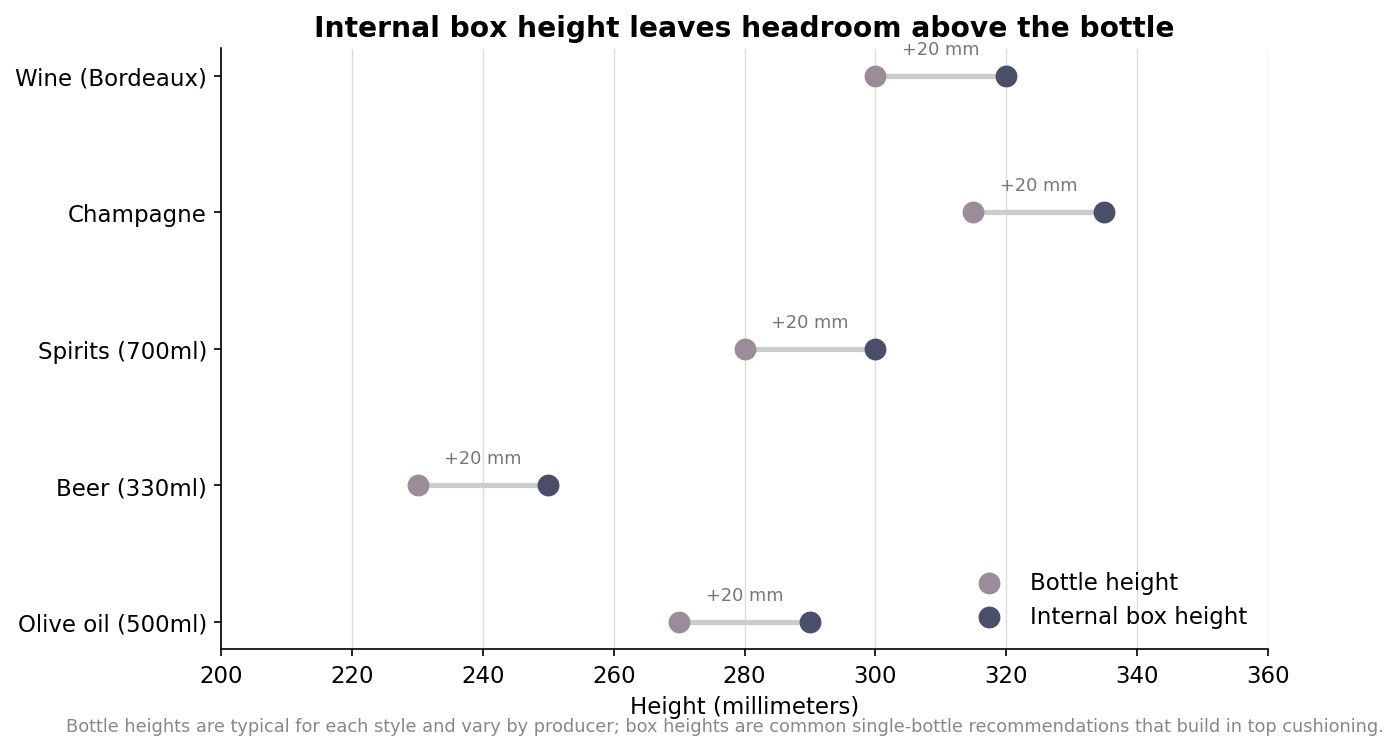
Height needs its own margin, separate from the side clearance. Leave roughly 15 to 25 millimeters of headroom above the closure so the lid seats without pressing on the cap and so a top cushion has somewhere to sit. That is why a Bordeaux bottle around 300 millimeters tall pairs with an internal box height near 320 millimeters. Get this wrong in the tight direction and the lid bows or will not close; get it wrong in the loose direction and the bottle telescopes upward on a drop and punches the top of the box. The dumbbell chart below shows the consistent headroom built into common single-bottle sizes.
Pick the format and the closure
Format follows the job. A corrugated mailer with a molded insert is the right answer when the box will travel through a carrier network on its own; it is engineered to absorb drops and is comparatively cheap at volume. A rigid setup box with a wrapped finish is the right answer for retail shelf presence or a gift that will be handed over in person, where the unboxing matters more than freight economics. Many brands run both: a handsome rigid box nested inside a plain corrugated shipper for e-commerce.
Closure sets the moment the box is opened. A tuck-end or auto-lock bottom is fast to pack and fine for shippers. A magnetic-closure rigid box feels premium and reusable but adds cost and weight. A lift-off lid or a sleeve-and-tray reads as a gift and slows the reveal in a good way. Decide single versus multi-bottle here too, because a two- or three-bottle box needs dividers so each bottle travels in its own pocket, and the combined weight climbs fast: a full 750-milliliter wine bottle runs roughly 1.2 to 1.3 kilograms, so a three-bottle presentation is approaching four kilograms before the packaging, which changes both the board grade you need and the shipping cost.
Proof it, then test-fit before the run
Before you approve artwork, confirm the dieline lists internal dimensions, not external, because the printer’s tooling is cut to the outside and a few millimeters of board thickness on each wall eats into the space the bottle actually sees. Order a physical sample or a plotter-cut mockup and put your real bottle into it. Check that it slides in cleanly, that the insert holds it still when you tip and gently shake the closed box, and that the lid seats flat. The figures in this guide are typical planning numbers and vary by bottle mold, board caliper, and insert type, so treat them as a way to get close and let a test-fit settle the final dimensions. A box you have personally loaded and closed around the exact bottle is worth more than any spec table.