A custom bottle box is one of those orders where the details are the whole job. The artwork can be beautiful and the price can be right, and the project can still go wrong because the insert is a few millimeters too tight, the board is too thin for the weight it carries, or the order was placed two weeks too late for the date it was meant for. Most of the expensive missteps are predictable, and they cluster around the same handful of decisions. Here are the five that catch buyers most often, and the concrete way to avoid each one.
Mistake one: assuming every 750 ml bottle is the same size
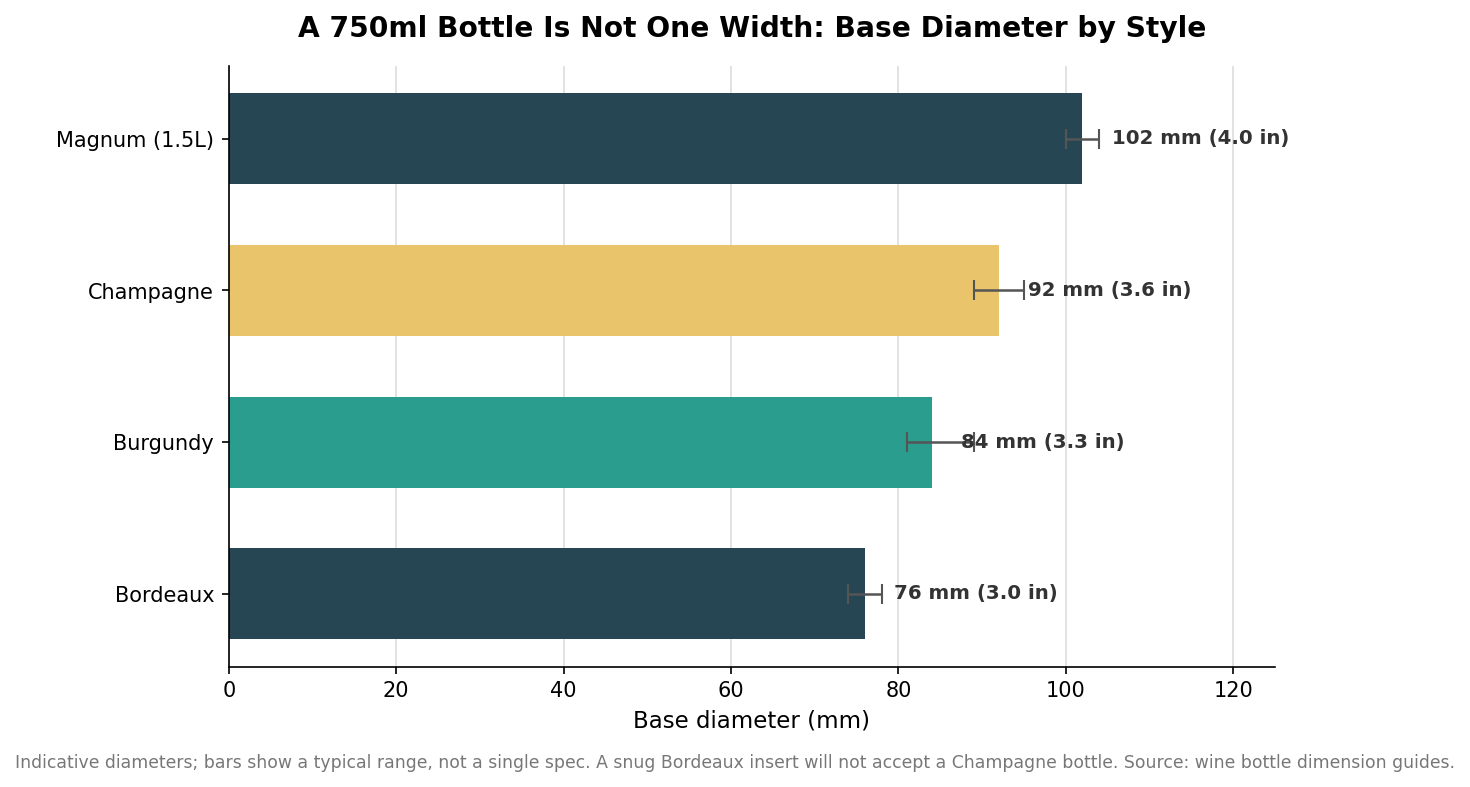
The most common and most costly error is treating “750 ml” as a single dimension. It is a volume, not a shape, and the common wine styles differ enough at the base that an insert cut for one will not accept another. A Bordeaux bottle runs around 76 mm across; a Burgundy is noticeably wider at roughly 84 mm; a Champagne bottle, built for pressure, is wider still at about 92 mm; and a magnum jumps to around 102 mm. A snug Bordeaux die-cut simply will not take a Champagne bottle, and a box sized for Champagne leaves a Bordeaux rattling. Before you approve anything, measure the actual bottle you are shipping, at its widest point and its full height with the capsule on, and spec the insert to that. If you plan to pack more than one bottle shape over time, size to the largest or order separate inserts rather than hoping one fits all.
Mistake two: choosing the board for its print surface, not its load
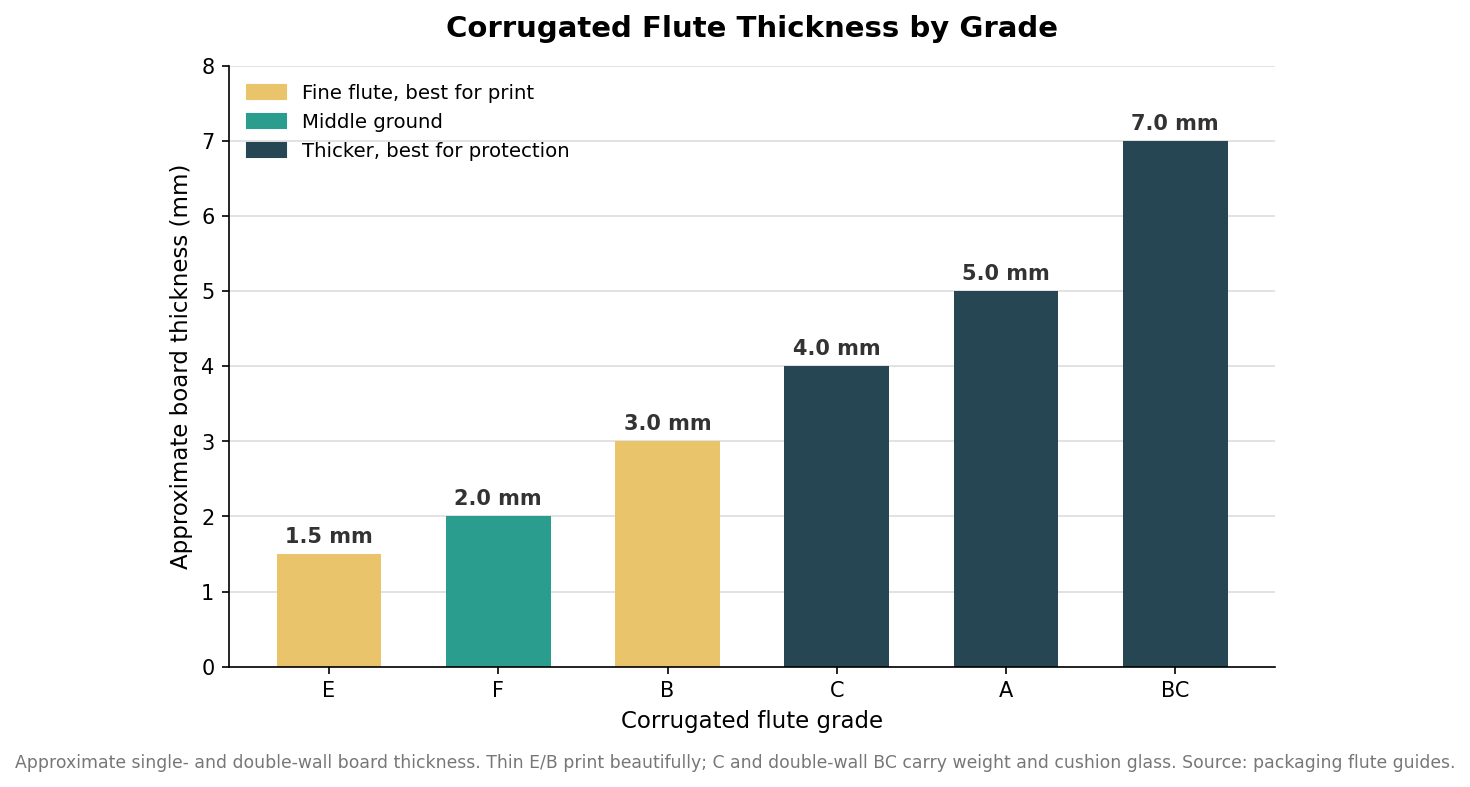
Corrugated comes in flute grades, and they are not interchangeable. Thin fine flutes like E at roughly 1.5 mm and B at about 3 mm give a smooth face that prints beautifully, which is exactly why buyers reach for them, and exactly how a heavy glass bottle ends up in a box that crushes in transit. The thicker grades exist for a reason: C flute at around 4 mm balances printability with cushioning, and double-wall BC at about 7 mm is built to carry weight and absorb shock. The right move is to let the job decide. A retail box that sits on a shelf and is carried home can lean on a fine flute for the print; a box that will be couriered with a full bottle inside wants C or a double-wall, often with a printed sleeve or litho-laminated liner so you still get the finish without giving up the protection. Pick the strength first, then solve for print.
Mistake three: confusing a gift box with a shipper
A presentation box and a shipping box are two different products, and buying one when you need the other is a quiet disaster. A magnetic-closure rigid box or a slim printed carton is designed for the unboxing moment: it looks and feels premium in the hand, but it is not engineered to survive a parcel network alone. If a bottle is going to travel by carrier, it needs a box and insert system that has actually been drop-tested, and if the contents are alcohol there are carrier and legal rules layered on top of the packaging question. The clean solution is to separate the two jobs. Let the beautiful box be the gift, and put it inside a tested shipper, or choose a mailer specifically rated for glass. Do not ask a gift box to do a shipper’s work, and do not ship wine without confirming both the drop performance and the rules that apply to where it is going.
Mistake four: designing artwork without the substrate in mind
Print does not look the same on every surface, and designs approved on a screen can disappoint on the real material. A photographic, full-color design that sings on a coated rigid box can look muddy printed directly onto brown kraft corrugated, because the surface and its color shift everything. Premium effects add their own rules: foil stamping, embossing and spot gloss read very differently on a smooth coated stock than on an uncoated or fluted one, and fine flutes can telegraph washboarding through a solid ink area. Decide the material and finish early, ask for a physical proof or a production sample on the actual stock rather than signing off on a flat digital rendering, and design to the substrate’s strengths. It is far cheaper to adjust a file than to reprint a run.
Mistake five: underestimating minimum orders and lead time
Custom packaging runs on tooling and schedules, and both take longer than a first-time buyer expects. Custom die-cuts, print plates and rigid-box setup carry minimum order quantities and setup costs that only make sense across a run, and the more specialized the format, the higher the floor. Lead times stack up too: design and proofing, then production, then any finishing, then transit, and the calendar does not care that your launch, your wedding, or your holiday gifting window is fixed. The fix is simple discipline. Ask for the MOQ and the full lead time in writing before you fall in love with a format, build in a buffer for a second proof round, and back-plan from the date the boxes must be in hand rather than the date you would like to order. A rush on a bespoke box is either impossible or expensive, and usually both.
None of these mistakes require special expertise to avoid; they require measuring the real bottle, matching the board to the load, keeping the gift box and the shipper as separate jobs, proofing on the actual material, and starting early enough to breathe. Handle those five and the rest of a custom bottle box order tends to go smoothly, which is exactly what you want from packaging whose entire purpose is to make the thing inside feel considered.