A bottle box has one job that a normal carton does not: it has to protect a heavy, fragile, top-heavy glass object that will be dropped, stacked, and thrown by people who do not know or care what is inside. Whether you are a winery shipping direct to consumers, a distillery building a retail gift box, or a brand assembling wedding favors, the material and structure you choose is the difference between a package that arrives intact and one that arrives as a bag of shards and an apology email. This is a deep dive into what bottle boxes are actually made of, and how each layer contributes to keeping glass safe.
Two families: rigid gift boxes and corrugated shippers
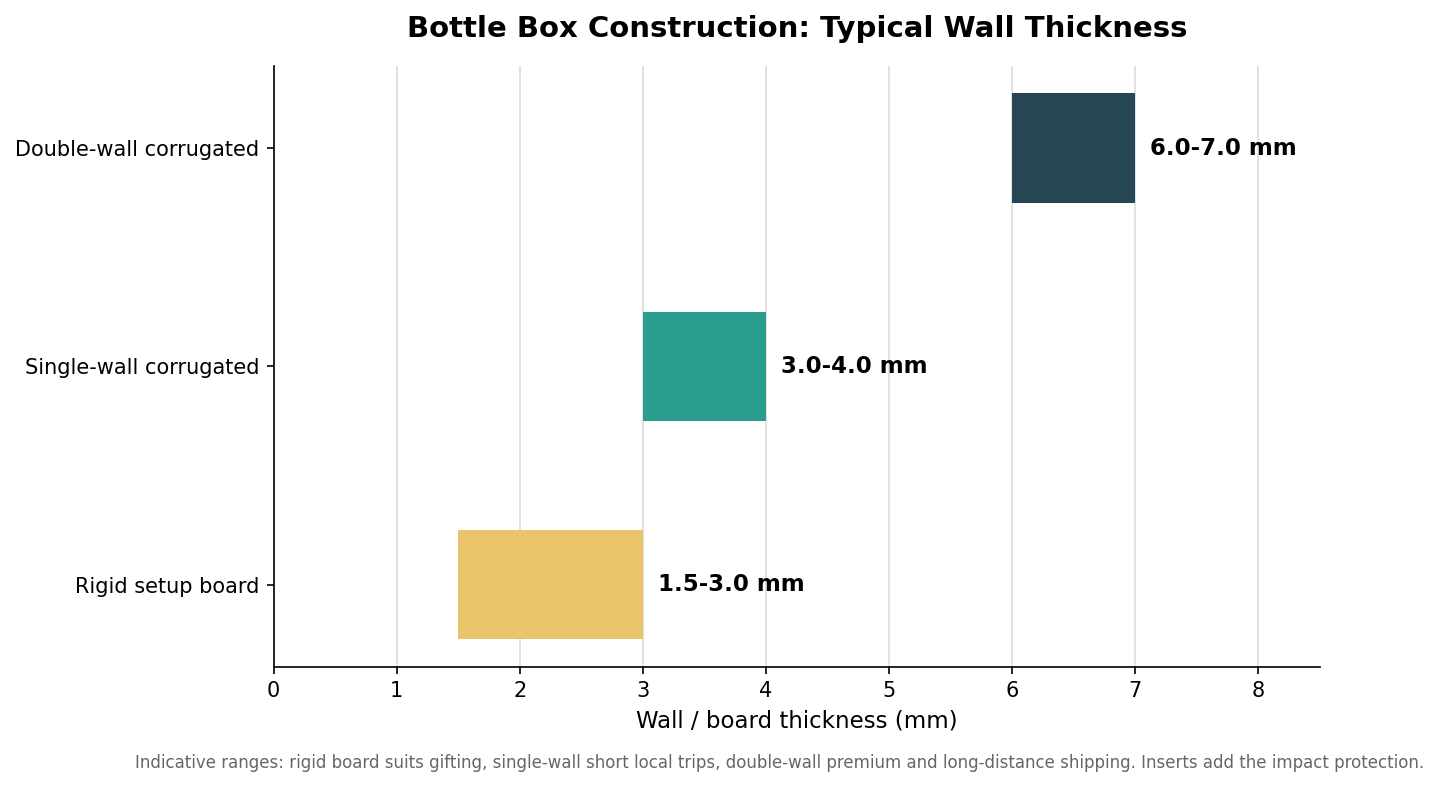
The first fork in the road is what the box is for. Rigid, or setup, boxes are the premium presentation pieces: thick solid board, typically in the range of 1.5 to 3 millimeters, wrapped in printed paper, the kind of box a bottle of premium spirit sits in on a shelf or under a ribbon. They feel substantial and distribute impact across the whole structure, but on their own they are built for display and hand-carry, not for the punishment of a parcel network. Corrugated boxes are the opposite: engineered shippers whose fluted construction is designed to absorb shock and survive stacking. Many high-end products use both, a rigid box for the unboxing moment nested inside a corrugated shipper for the journey.
Getting this distinction right up front saves money and breakage. Spending on a beautiful rigid box and then shipping it in a flimsy mailer is how expensive bottles break; conversely, over-engineering a shipper for a box that will only ever be handed across a counter wastes material. Decide whether the box is presenting, protecting, or doing both, and the rest of the spec follows.
Flutes: the corrugation that does the cushioning
The wavy layer sandwiched inside corrugated board is called the flute, and its profile is the single biggest lever on how a shipper performs. Taller flutes cushion more; finer flutes print sharper and pack thinner. The common profiles run from the chunky A flute down to the ultra-fine F, with B, C, and E in between. A and C flutes, being taller, give the best shock absorption and stacking strength, which is why they dominate general shipping of fragile goods. E and F flutes are thin and smooth, prized for crisp retail printing and slim luxury packaging rather than raw protection. The chart below shows the caliper of each profile so the trade-off is visible at a glance.
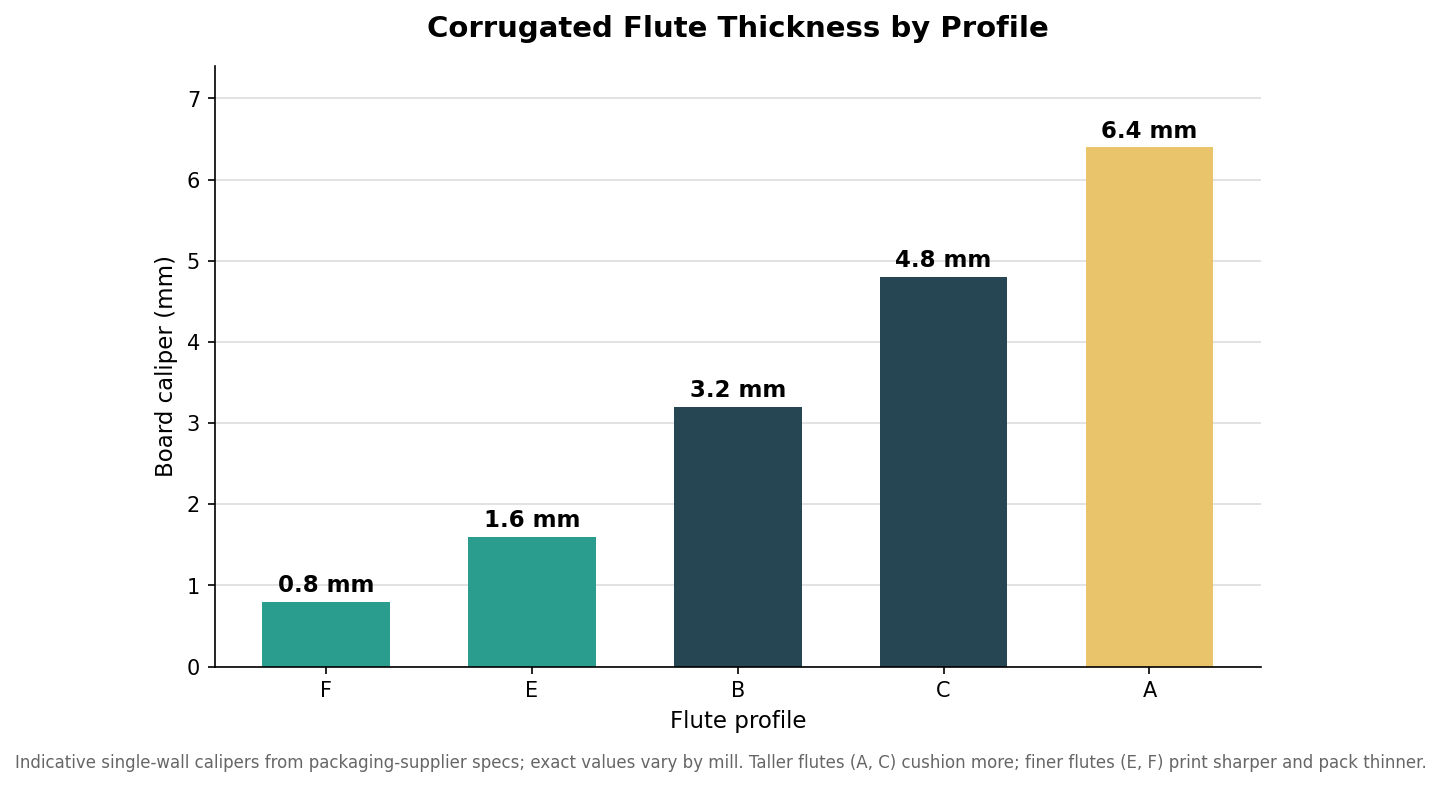
For bottles specifically, the flute choice usually pairs a protective profile for the outer shipper with a finer profile where print quality matters. That is exactly what double-wall combinations like BC do: a B flute laminated to a C flute gives you both the cushioning of the taller flute and a more printable, rigid overall board, which is why BC is a workhorse for palletized bottle shipments.
Single wall, double wall, and how many bottles
Beyond flute profile is the question of how many layers. Single-wall board, roughly 3 to 4 millimeters thick, handles lightweight bottles over short, gentle trips; double-wall, around 6 to 7 millimeters, is the standard for premium wines, heavier bottles, and anything crossing the country or an ocean. As a rough guide from supplier specs, a six-bottle double-wall carton is commonly rated for around 20 kilograms, while larger twelve-to-twenty-four-bottle cases built from an E/B-flute hybrid can carry roughly 50 kilograms. The chart below sketches how the constructions compare on wall thickness.
Bottle count changes the physics, not just the size. A single bottle needs to be held dead center, away from every wall, because the corners and faces are where drop energy concentrates. Multi-bottle packs add a second danger: bottles knocking into each other. That is why the divider or insert matters as much as the outer box, and often more.
Inserts: what actually stops the glass from breaking
The outer box resists crushing and stacking; the insert resists impact and keeps bottles apart. There are three mainstream approaches. Molded pulp, shaped from recycled paper to cradle the bottle’s curves, is the most popular for wine and spirits because it suspends the bottle away from the walls, absorbs shock, nests compactly, and is fully recyclable and on-brand for sustainability messaging. Corrugated dividers and partitions, the folding grid you see in a case of wine, are cheap and effective at stopping bottle-on-bottle contact in multipacks. Foam, cut with bottle-shaped holes, often around 80 millimeters in diameter, with thin pads layered between tiers, gives precise, high-end protection at a higher cost and with a heavier environmental footprint. Air-cell wraps are a fourth option that cut packed volume significantly and deflate for disposal.
For most direct-to-consumer wine and spirits shipping, molded pulp inside a double-wall corrugated shipper has become the default because it balances protection, cost, weight, and recyclability. For retail-ready multipacks, corrugated partitions inside a BC-flute case do the job economically. Reserve foam for genuinely high-value or oddly shaped bottles where its precision earns its cost.
Specifying for the trip, not the shelf
The last principle is to design for the worst moment the package will face, which is almost always transit rather than display. Reputable bottle packaging is validated against transit-simulation protocols such as the ISTA drop and vibration tests, and asking a supplier whether a design has passed that testing is a fair and revealing question. Match the outer material to the journey: rigid or single-wall for hand-off and local delivery, double-wall with a molded-pulp or partition insert for the parcel network.
Finally, remember that structure and appearance are not in conflict. Kraft board reads natural and sustainable and takes one-color printing beautifully; white-topped or paper-wrapped board carries full-color artwork for a premium look. You can put a fine E-flute printed sleeve or a rigid presentation box around a double-wall protective core and get both the unboxing moment and the safe arrival. Decide the protection first, then the presentation on top of it, and the bottle shows up whole and looking the way you intended.