Two things decide whether a bottle arrives intact and whether you are allowed to send it at all: the box has to survive a parcel network built for tumbling, stacking, and drops, and the shipment has to satisfy a web of federal and state alcohol rules that treat wine differently from almost anything else you can mail. Get the packaging right but ignore compliance, and a shipment can be refused or returned. Get the paperwork right and skimp on the box, and you are paying to ship broken glass. This guide walks through both, in the order you should think about them.
Start with the carriers, because they narrow your options fast
The first surprise for many first-time shippers is that the Postal Service is out entirely. Federal law prohibits USPS from carrying beer, wine, or spirits, so the cheapest option most businesses reach for is simply unavailable for alcohol. That leaves the two national private carriers, UPS and FedEx, and both require you to enroll in a dedicated alcohol program before a single bottle moves. FedEx asks shippers to sign up for its alcohol shipping program and provide proof of the appropriate licenses. UPS requires a signed contract, either an Agreement for Approved Wine Shippers or a Wine Industry Fulfillment House Agreement, with license copies submitted to its wine compliance team.
The practical consequence is that individuals cannot legally ship wine through either carrier. Only licensed businesses qualify, and the license has to match the product and the lane. Every alcohol delivery also requires an adult 21 or older to sign at the door, with no waiver and no leave-at-door option. Build that into your customer expectations, because a missed signature means a re-attempt or a return, not a doorstep hand-off.
The state map is the real constraint
Carrier enrollment gets you moving, but state law decides where you can actually deliver. Direct-to-consumer wine shipping is governed state by state, and the patchwork is genuinely uneven. Most states that permit DTC wine require the recipient to be 21 or older and the shipper to hold a permit for that state. A handful, including Alabama, Utah, and Arkansas, prohibit or heavily restrict DTC wine altogether, so a box addressed there may be undeliverable no matter how well it is packed. Beer and spirits are stricter still: in most cases they are limited to licensee-to-licensee shipments, meaning the recipient must itself be a licensed alcohol business rather than a consumer. If your packaging program is built around gift shipments to individuals, confirm the destination state allows it before you promise a delivery date.
What surviving shipping actually means
Once you can legally ship, the box has to do its job. The relevant benchmark for parcel-shipped bottles is ISTA 3A, the International Safe Transit Association test for individually shipped packages moving through a small-parcel network, generally under 150 pounds. It is not a single drop; it is a sequence that mimics the abuse a box takes in a real hub: atmospheric conditioning, a compression phase that simulates sitting at the bottom of a stack, random vibration on a shaker table, and a series of drops on faces, edges, and corners. A shipper that passes ISTA 3A has been shown to protect its contents through that whole cycle, not just one gentle test. When a supplier advertises a wine shipper as ISTA 3A tested, that is the claim worth looking for, because it maps directly to how carriers actually handle parcels.
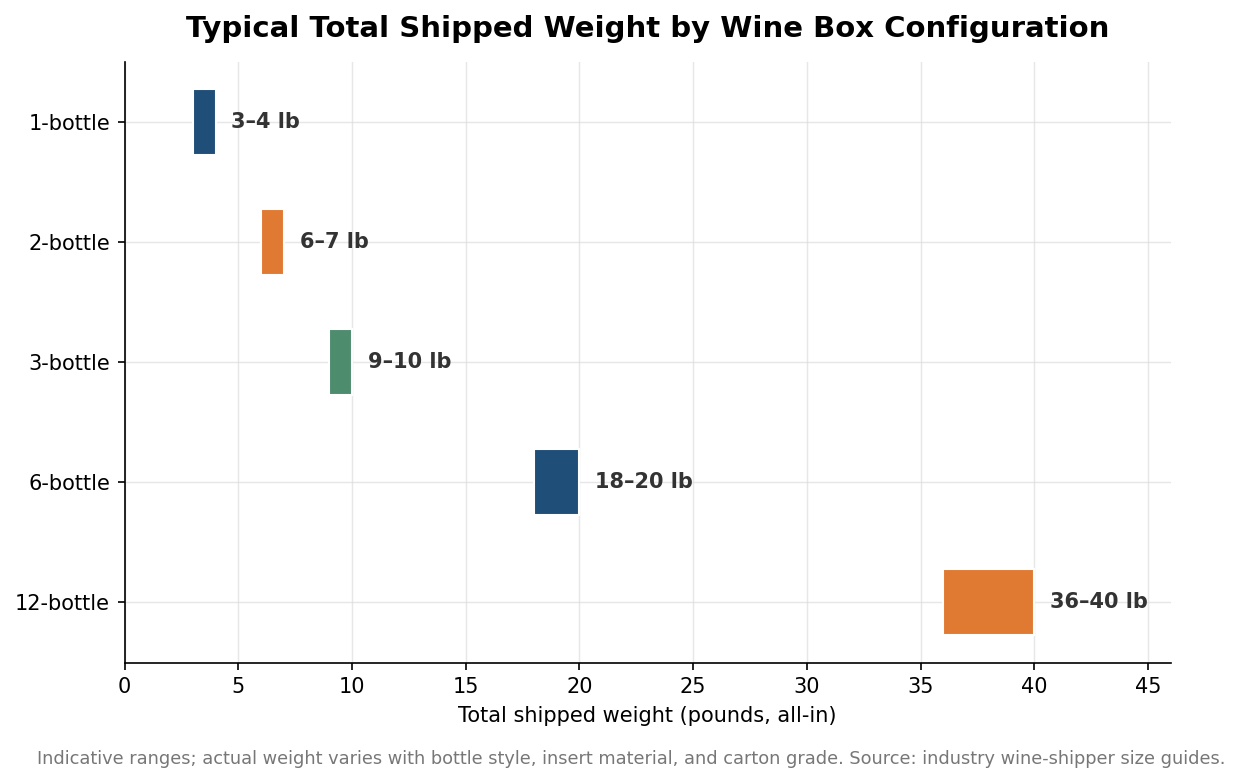
Total shipped weight matters here too, for cost and for how the box behaves. As an indicative range, a single-bottle shipper runs about 3 to 4 pounds all in, a two-bottle around 6 to 7, a three-bottle roughly 9 to 10, a six-bottle in the 18-to-20 range, and a twelve-bottle box lands near 36 to 40 pounds. Those figures are approximate and shift with bottle style and insert material, but they are close enough to plan freight and to notice when a quote looks wrong.
Choosing the insert: pulp, foam, or corrugated
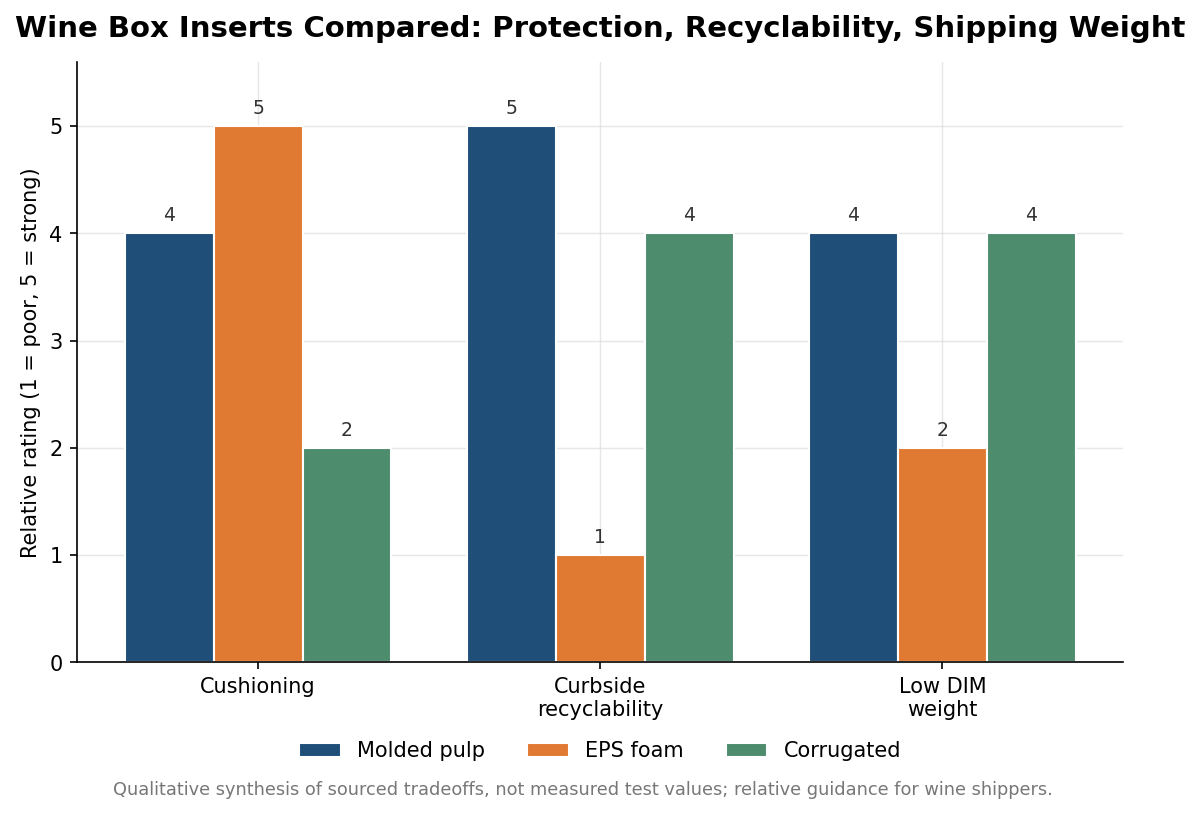
The insert is what separates a bottle from its neighbors and from the carton wall, and the three common choices behave very differently. Molded pulp forms a product-specific cavity around each bottle so there is no movement and no glass-on-glass contact, and it is typically made from recycled paper that is curbside recyclable and compostable in most US markets, which increasingly matters to the brands sending the gift. EPS foam offers strong raw shock absorption and is favored for high-value fragile goods, but generic cut shapes can let a bottle shift on longer routes, the material adds dimensional bulk that raises DIM-weight charges, and it is not curbside recyclable and is banned from disposal in California, New York, and several other states. Corrugated dividers are the cheapest option and are good at organizing bottles and resisting stacking pressure, but they cushion relatively little and should rarely be the only protection under a glass bottle.
The rough hierarchy for most DTC wine programs is pulp for the balance of protection, recyclability, and shipping cost; foam when maximum shock absorption outweighs the environmental and DIM penalties; and corrugated as a structural helper rather than a standalone cushion. Whatever you choose, pair it with an outer carton rated for the weight, because a twelve-bottle box near 40 pounds needs a stronger board grade than a single-bottle mailer.
Specifying a box that is both compliant and drop-tested
Put the two halves together and a good specification reads like a short checklist. Confirm the destination state allows the shipment and that you hold the matching permit; enroll with UPS or FedEx under the correct alcohol agreement; size the box to the bottle count and style you actually ship, since a Burgundy or sparkling bottle is fatter and taller than a standard Bordeaux and will not seat in a cavity cut for the wrong shape; choose an insert, pulp for most cases, that holds each bottle with no movement; and ask the supplier for ISTA 3A test evidence rather than a general promise of durability. Do that, and the box stops being the weak link. The wine arrives standing up, the recipient signs for it, and the only thing your customer remembers is the bottle, not the packaging around it.
A note on the figures: the shipping weights and state rules above are indicative and change over time. Verify current carrier agreements and state DTC permits before you commit to a lane, since alcohol regulations are updated more often than most shipping rules.